

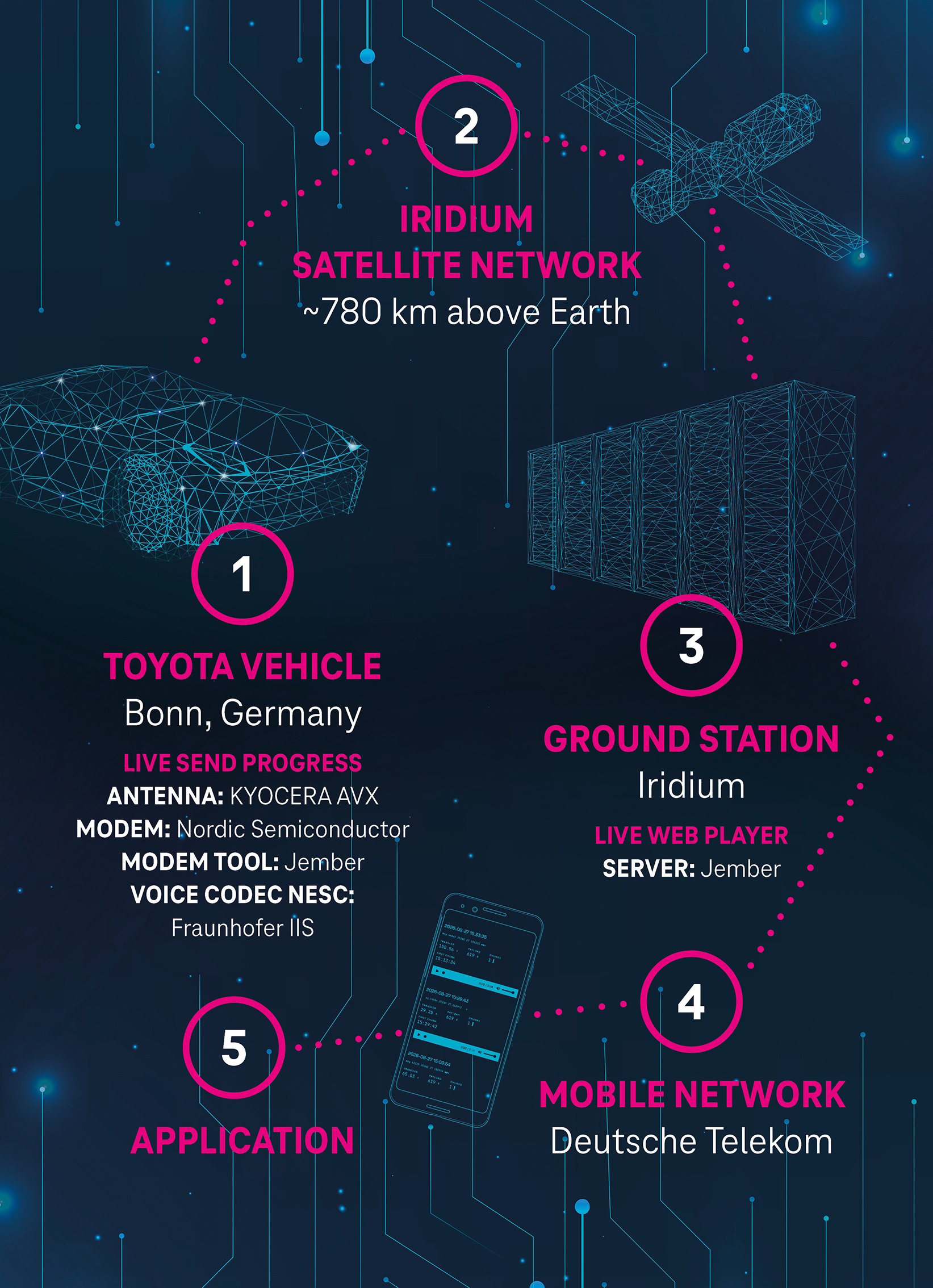
Deutsche Telekom is expanding its multi-orbit IoT roaming solution with Iridium as an additional LEO satellite partner. A practical example was demonstrated at Deutsche Telekom Satellite Day 2026. A Toyota vehicle sent a NESC-encoded voice message via Iridium’s satellite network to a simulated call center.
Successful transmission of voice message
The message was transmitted using standards-based NB-IoT technology and encoded with NESC, the AI-based Voice Codec from Fraunhofer IIS.. The demonstration showed how a vehicle can stay connected outside terrestrial network coverage. In everyday use, this type of connectivity could help vehicles and other assets continue to send important information when they are travelling through remote areas or when an additional layer of resilience is required while terrestrial networks are temporarily unavailable.
“The voice message sent over our network from a Toyota vehicle illustrates how Iridium NTN Direct will enhance consumer and commercial applications for people and assets operating outside traditional coverage areas,” said Matt Desch, CEO, Iridium. “This demonstration is a glimpse into the future of truly global, standards-based connectivity. Now is the time for all IoT solution developers to begin integrating 5G standards-based Iridium connectivity into their products.”
The showcase brought together seven partners: Deutsche Telekom IoT, Iridium, Toyota Motor Europe, Nordic Semiconductor (radio module), Fraunhofer IIS (NESC voice codec), KYOCERA AVX (antenna) and Jember (integration). It demonstrated how satellite connectivity, mobile networks, standard IoT hardware, connected vehicles and voice technology can work together to create new IoT services beyond the reach of terrestrial networks.
In February 2026, Deutsche Telekom officially launched the world’s first commercial multi-orbit IoT connectivity offering while announcing Iridium as fourth roaming partner. It combines terrestrial mobile networks with satellite services in geostationary (GEO) and low Earth orbit (LEO). The solution enables IoT devices to transmit data seamlessly via the most suitable available network.